Real Estate Management
Here is the English translation of the text provided:
Using a property manager's personal WhatsApp as an incident management channel has a fundamental underlying issue that goes beyond mere inconvenience: there is no system. And without a system, there is no prioritization, no follow-up, no historical record, there is nothing.
There is no prioritization. A message from a tenant reporting a minor leak appears in the exact same list as one reporting a gas leak. If the manager isn't looking at the right moment, both have the same visibility, or none at all.
There is no automatic follow-up. If the manager forwards a message to the plumber and receives no reply, the incident remains in limbo. Nobody closes it. Nobody updates the tenant. The tenant messages again two days later asking what happened, generating even more work.
There is no usable history. If a year later there is a dispute over the deposit and the tenant claims they reported several unresolved issues, the only existing record consists of thousands of mixed messages in a WhatsApp chat. Trying to rebuild a specific property's history under those conditions is a nightmare.
There is no team visibility. If the manager responsible for a property goes on vacation, a colleague has to read through their entire personal WhatsApp history to understand the status of pending issues. That assumes the colleague even has access to the phone, which they normally don't.
The solution isn't trying to convince tenants to use a different app, that simply doesn't work. The solution is connecting the channel they already use (WhatsApp) to a structured system.
An AI incident agent acts as an intelligent intermediary between the tenant and the agency's management system. Here is how it works:
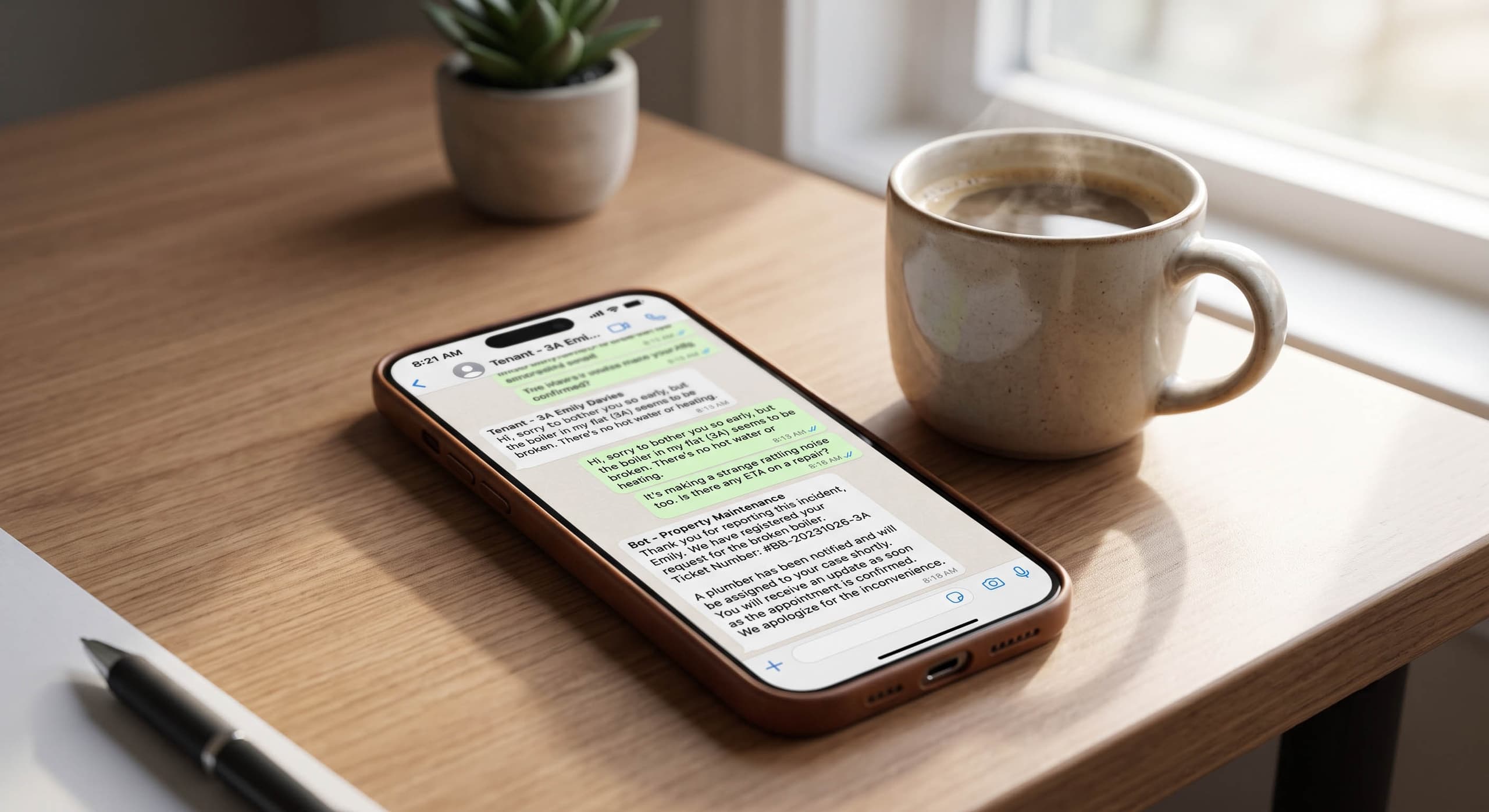
The tenant writes to the agency's WhatsApp as usual. They don't need to download anything or create an account. They just write a message describing their issue, exactly as they would today.
The AI agent receives and processes the message. This is where the magic happens: the system understands natural language, identifies that it is an incident (and not a query about a lease or payment), extracts relevant information from the message, and enriches it with the tenant and property data already stored in the system.
The agent automatically classifies and prioritizes.
Safety risk emergencies (gas leaks, flooding, electrical failures): High urgency, immediate notification to the property manager and vendor.
Non-immediate risk repairs (broken appliance, stuck blind): Medium urgency, assigned during the next work cycle.
Non-incident queries: The agent responds directly or redirects to the appropriate channel.
A ticket is created automatically in the system. Complete with ticket number, description, attached photos (if sent by the tenant), linked property and tenant profiles, and assigned urgency level. The manager doesn't have to lift a finger, the ticket exists from the very first message.
The agent confirms registration to the tenant. Automatically, in the same WhatsApp chat: "Hello [Name], we have registered your incident (#INC-1847). We will keep you updated on the next steps. If the situation worsens, please let us know." The tenant instantly knows someone (or something) is handling their issue.
The system assigns the correct vendor. Based on the incident category and availability of approved agency vendors, the system notifies the contractor directly. The manager only steps in to approve estimates or handle edge cases requiring human judgment.
Incident closure is recorded automatically. Once the vendor confirms resolution, the system closes the ticket, notifies the tenant, and updates the property's historical log.

For an agency managing 80 properties, monthly incidents typically range between 30 and 60, depending on property age and condition. Handling each one manually carries an estimated cost of 20 to 45 minutes per incident (receiving the message, understanding context, finding a vendor, communicating, following up, closing).
With an automated AI system:
Manager handling time is reduced to 20–30% of the total (only for decisions requiring human criteria).
Tenant response times drop from hours to seconds.
The historical record for every property is built automatically, with no extra work.
In terms of raw hours, we are talking about reclaiming 15 to 30 hours per month for an 80-property portfolio. Hours that can be spent acquiring more property owners, improving service quality, or simply reducing team workload.
Incident management is one of the most critical "moments of truth" in the relationship between an agency and its clients, both tenants and property owners.
For the tenant: Receiving an immediate response when reporting a problem completely changes their perception of the service. Even if the actual repair takes a few days, satisfaction comes from feeling that their issue was acknowledged right away. A tenant who feels heard renews their lease; one who feels ignored starts looking elsewhere.
For the property owner: A complete log of managed incidents is one of the most valuable reports you can present: "This year we managed 7 incidents at your property: 2 plumbing, 3 general maintenance, and 2 appliance repairs. Average resolution time was 48 hours." That level of reporting transforms how owners perceive the agency's added value.
An owner who sees that level of transparency and efficiency doesn't ask if they are paying too much in fees, they wonder why they didn't find your agency sooner.
Many agencies already use basic ticketing setups (Trello, Notion, or even shared spreadsheets) to log incidents. The difference with an AI agent is that basic systems require someone on the team to manually create the ticket after receiving the tenant's message.
With AI, the ticket creates itself right from the tenant's first message, with all relevant details already linked. The manager doesn't need to copy-paste, search for property details, or write out descriptions. The system handles it all.
It's the difference between having an organized filing cabinet and having a filing cabinet that organizes itself.

Centralize the channel. If incidents currently land on personal cell phones of various managers, the first step is centralizing into a single WhatsApp Business line for the agency. This is the number that connects to the AI agent.
Configure your vendor catalog. The AI agent needs to know who to assign to each incident type. Create a list of approved vendors by category (plumbing, electrical, locksmith, appliances) and set it up in the system.
Define urgency levels. Establish which incident types require immediate manager notification (safety risks) and which can be handled during normal operational cycles.
Communicate the change to tenants. A simple message in existing WhatsApp chats: "Starting on [Date], all property incidents will be managed through our new system. Message us here for immediate assistance." Nothing more is needed.
Review after the first month. Use the first 30 days to fine-tune: identify misclassified incident types, see which vendors respond best, and spot tenant phrasing that confuses the system. After these minor tweaks, the system runs on autopilot.
Tenant incident management doesn't have to be the chaotic process it is in most agencies. With an AI agent connected to WhatsApp, a workflow that currently consumes hours of manual labor per week transforms into a background automated process that runs faster, offers complete traceability, and delivers a far better experience for everyone involved.
The time you reclaim doesn't vanish, it gets redirected back into the high-value work that actually demands your professional expertise.
Discover how pisopro can help you implement all these strategies and automate your property management.
Request demoSign in with Google to leave a comment
Loading comments...
Decision guide: what software for real estate agencies must include, who it is for, which modules matter, and when switching pays off.
Real Estate ManagementAI for property management: leads, incidents, Pepe’s end-to-end flow, and what still needs a person.
Real Estate ManagementReal estate CRM for agencies and rentals: lead-to-close flow, generic CRM vs operations, and how it looks in pisopro.