Real Estate Management
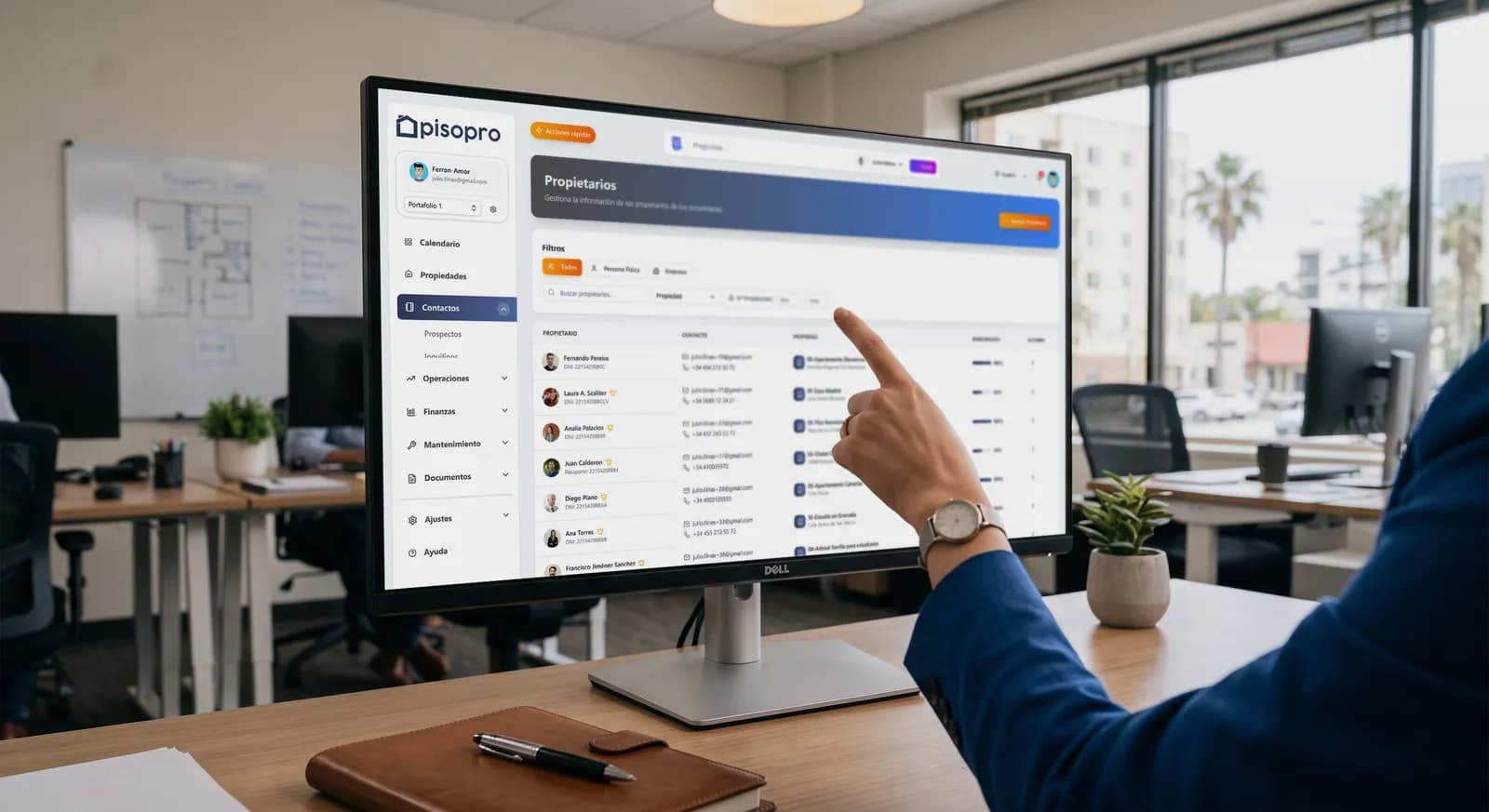
AI for property management —also searched as AI for real estate administration— is no longer a slogan. It is how an agency answers leads, classifies incidents, coordinates maintenance, follows up, and communicates without opening eight inboxes.
This guide answers that intent directly. These are the use cases agencies usually start with:
Then you will see a real Pepe flow from start to finish, and what still needs a person.
If you still copy WhatsApp into the CRM and the portal into Excel, the bottleneck is not headcount: it is work that does not require judgment. AI executes it; your team decides. The rest of the article turns that into tasks, numbers, and buying questions.

AI in real estate management is not science fiction and is not experimental. These are the tasks agencies are automating with AI right now:
The rent collection cycle is perfectly predictable: same amount, same frequency, same tenant. AI can manage this entire cycle without human intervention: execute collection on the scheduled date, immediately detect when it has not occurred, send the first notice to the tenant on the correct channel, follow up automatically, and escalate to the human manager only when there is a real problem requiring judgment.
In practice, this means collection management for a portfolio of 100 properties goes from being a task taking 3-4 hours weekly to something that happens automatically, with the team intervening only in exceptional cases.
Annual rent review according to CPI or the applicable reference index is a mechanical task: calculate the update, generate the legal communication to the tenant with the correct advance notice, update the amount in the system. With AI, the system does it alone on the corresponding date for each contract, with the correct index and appropriate legal format.
When a tenant reports an incident, AI can:
The result is that response time to the tenant drops drastically and the time the team spends coordinating routine incidents drops too.
Contracts, renewals, rent update communications, handover records, settlements to owners. All these documents follow predictable structures with variables already in the system. AI generates them in seconds from registered data, without anyone having to open a Word template.
Gross and net profitability per property. Historical occupancy. Market comparison. Cash flow projections. AI can automatically generate these reports for each owner at the close of each period and keep them updated in real time in the owner portal.

To understand the real impact, it is useful to compare the weekly operation of a medium-sized agency before and after implementing AI in management:
Without AI, portfolio of 80 properties:
With AI, same portfolio of 80 properties:
The difference, between 12 and 18 weekly hours freed, represents capacity to grow the portfolio, improve client service, or simply do the work that really adds value to the agency.
AI in property management does not operate in a vacuum. To work well, it needs quality data in a centralized system. This has an important implication: if your information is scattered across spreadsheets, emails, and WhatsApp chats, the first step is not AI, it is centralization.
The data AI needs to work:
When this data is in a centralized, updated system, AI can do its job. Without it, AI has nothing to work with.
The market is full of tools claiming to include AI. Most offer, at best, basic automations disguised with the buzzword. Before hiring any tool with AI promises, it is worth asking the right questions:
Does the AI operate proactively or only reactively? Useful AI detects that a contract will expire in 60 days and triggers actions without anyone asking. Basic automation only acts when someone clicks a button.
Does the AI make decisions or only suggest? In real estate management, quality AI can make routine management decisions (assign incident to the plumber on the list, send non-payment notice on the correct channel) without human intervention, and escalate only when there is ambiguity or exception.
Does the AI learn from your portfolio patterns or apply generic rules? An advanced AI system can detect that a specific tenant always pays 3-4 days late and adjust the notice flow to avoid unnecessarily saturating them. A basic one treats everyone the same.
What happens when the AI is wrong? The best AI systems have clear human supervision and correction mechanisms, with logs of all automatic actions and the ability to intervene or revert.
Pepe is pisopro’s AI employee. It is not a generic chatbot: it lands in the same inbox as WhatsApp, Idealista, Fotocasa, email, and social, recognizes whether the message is a lead or an incident, and runs the property-administration flow.
That is the work agencies still do by hand, and what AI for property administration can run when the unit and the contract are already in context.
See Pepe’s flow in a demo → · Meet Pepe
pisopro is designed from its architecture so that AI is a real operational layer, not a marketing add-on. Automatic flows for collections, incidents, alerts, and documentation work from day one, without complex configuration and without the team needing to know anything about technology.
What distinguishes pisopro is that AI is integrated into the workflows agencies already have, it does not require changing how the agency works, but adapts to it and starts automating from the first property.
Agencies working with pisopro report that the most significant change is not the time saved (which is considerable), but the feeling of having the portfolio under control at all times, without having to manually review anything to be sure nothing has fallen through the cracks.
What can AI automate in property management?
Lead response, incident classification, routine maintenance, visit and ticket follow-up, and messages to tenant or owner. Collections and documents too, if the data is centralized.
Which channels does Pepe use?
WhatsApp, Telegram, portals (Idealista, Fotocasa and similar), email (Gmail, Outlook), and Instagram, Facebook, or LinkedIn. Each channel can run automatic or draft, 24/7 or business hours.
How does it integrate with property administration?
Pepe lives inside pisopro: the lead or incident is tied to the unit, the contract, and the history. It is not a loose layer you later paste into Excel.
Which tasks still need a person?
Negotiating price or terms, approving a large quote, legal disputes, unpaid rent that needs judgment, and any exception Pepe cannot resolve with the available context.
pisopro, property management with artificial intelligence for real estate agencies in Spain. pisopro.com
Keep exploring pisopro: property management software, software for real estate agencies, incident management, financial management, tenant portal and events calendar. You can also book a demo.
Discover how pisopro can help you implement all these strategies and automate your property management.
Request demoSign in with Google to leave a comment
Loading comments...
Practical guide to real estate automation: which processes to automate first, how to measure impact, and what tools actually work in 2026.
Real Estate ManagementThree years ago, "artificial intelligence for real estate" was a technology promise in conference slide decks. In 2026, it is the operational difference between agencies that are growing and those falling behind.
Real Estate ManagementThere are two types of real estate agencies in 2026: those that automate and those that still manually do what a system should do for them. The difference is not just efficiency, it is growth capacity. An agency that de