Real Estate Management

Three years ago, "artificial intelligence for real estate" was a technology promise in conference slide decks. In 2026, it is the operational difference between agencies that are growing and those falling behind.
We are not talking about robots selling flats or chatbots answering generic questions. The AI transforming real estate management operates in the invisible part of the business: the part that consumes the most time, generates the most errors, and adds the least value. Collections, contracts, incidents, notices, documentation. Everything a good administrator does well but that a system with AI does without mistakes, without forgetting, and without needing holidays. For use cases, Pepe, and buying FAQs, see AI for property management.
A medium-sized agency in Spain manages between 50 and 200 properties. Each property has a contract, a collection cycle, one or more owners who want information, an incident history, and critical dates to watch (contract expiration, CPI rent review, insurance renewal, deposit returned or retained).
Multiply that by 100 properties and you have thousands of data points in continuous motion that someone has to control. That "someone" has historically been an administrator or management coordinator, someone very valuable who inevitably becomes the agency bottleneck when the portfolio grows.
AI does not replace that person. It frees them to do what really adds value: serve owners, solve complex problems, capture new properties. What it automates are tasks that do not require judgment, only attention, memory, and systematic execution. Exactly what humans do worst when volume is high.

The traditional process: on the 6th of the month, someone manually checks which collections have not arrived, sends an email or calls the tenant, notes the follow-up somewhere, and waits for a response. If there is no response, they repeat the next day.
With AI: the system automatically detects the moment the expected collection has not occurred, generates communication to the tenant on the correct channel (email, SMS, WhatsApp), records the follow-up, and automatically escalates if there is no response within 48 hours. The team only intervenes when there is a real problem requiring human judgment.
The result: time spent on non-payment management drops between 70 and 80%. Detection is immediate. And resolution rates improve because the first notice arrives sooner.
Contracts expiring in 60 days. Insurance to renew. CPI rent reviews due to be applied. Deposits held with the official body to recover at the end of the lease.
An agency with 100 properties may have 30 or 40 of these critical dates active at any time. An AI system monitors them all, prioritizes the most urgent, and automatically generates the corresponding actions: owner notification, tenant communication, rent update document generation.
Without AI, this depends on manual calendar reminders or someone regularly reviewing a spreadsheet. In practice that means things get forgotten and agencies lose money (or lose clients) through inaction at key moments.
In Spain, rent updates in lease contracts are regulated and linked to the Consumer Price Index or the applicable reference index. Calculating it, communicating it to the tenant with the correct advance notice, and generating the supporting document is a repetitive process that happens every year for each contract.
A system with AI does it automatically: calculates the new amount on the corresponding date, generates the notification with the correct legal format, and updates the contract in the system. What used to take between 15 and 30 minutes per contract (multiplied by all contracts with a review that month) becomes completely transparent.
A plumbing fault in a vacant property does not have the same urgency as a gas leak in an occupied one. An AI system can automatically classify the severity of each reported incident, assign it to the appropriate provider by category and urgency, and notify the owner with the correct level of detail.
Without this system, all incidents arrive the same (usually by email or WhatsApp) and someone has to read, evaluate, and manage them one by one. With it, 80% of routine incidents are handled automatically and the team only intervenes in those requiring judgment or negotiation.
Lease contracts from parameterized templates. Rent update letters. Expiration communications. Key handover and return records. Monthly settlements to owners.
All these documents follow repetitive structures with variables that change (tenant name, address, amount, dates). An AI system generates them in seconds from data already in the system, without anyone having to open Word and copy and paste.
The owner wants to know how their investment is performing. Property occupancy, collections received, applied expenses, resolved incidents, net profitability for the period. Preparing that report manually for each owner every month can take between 20 and 45 minutes per client.
With AI, the report is automatically generated at the close of each period with real system data, personalized for each owner, and sent in the agreed format. Preparation time goes from hours to zero.
In 2026, practically all real estate software claims to include "artificial intelligence." Most exaggerate to the point that the AI they offer is indistinguishable from what any basic notification system does.
These are the questions you must ask before hiring any tool advertised with AI:
Does the AI learn from your portfolio patterns or apply the same fixed rules for everyone? Real AI adapts. Basic notifications do not.
Can the AI prioritize tasks based on multiple variables simultaneously? Incident urgency, tenant history, provider availability, owner preferences. If the system only sends emails when something specific happens, it is not AI, it is basic automation.
Does the AI generate complete documents or just fill fixed templates? There is a difference between a system that generates a correct contract adapted to the specific conditions of each lease and one that puts your name in a predefined Word file.
Does the AI analyze profitability and make recommendations or just show data? Useful AI can detect that a property has been vacant for 60 days with rent below market and suggest when and how to review it. One that only shows dashboards is not AI, it is business intelligence.
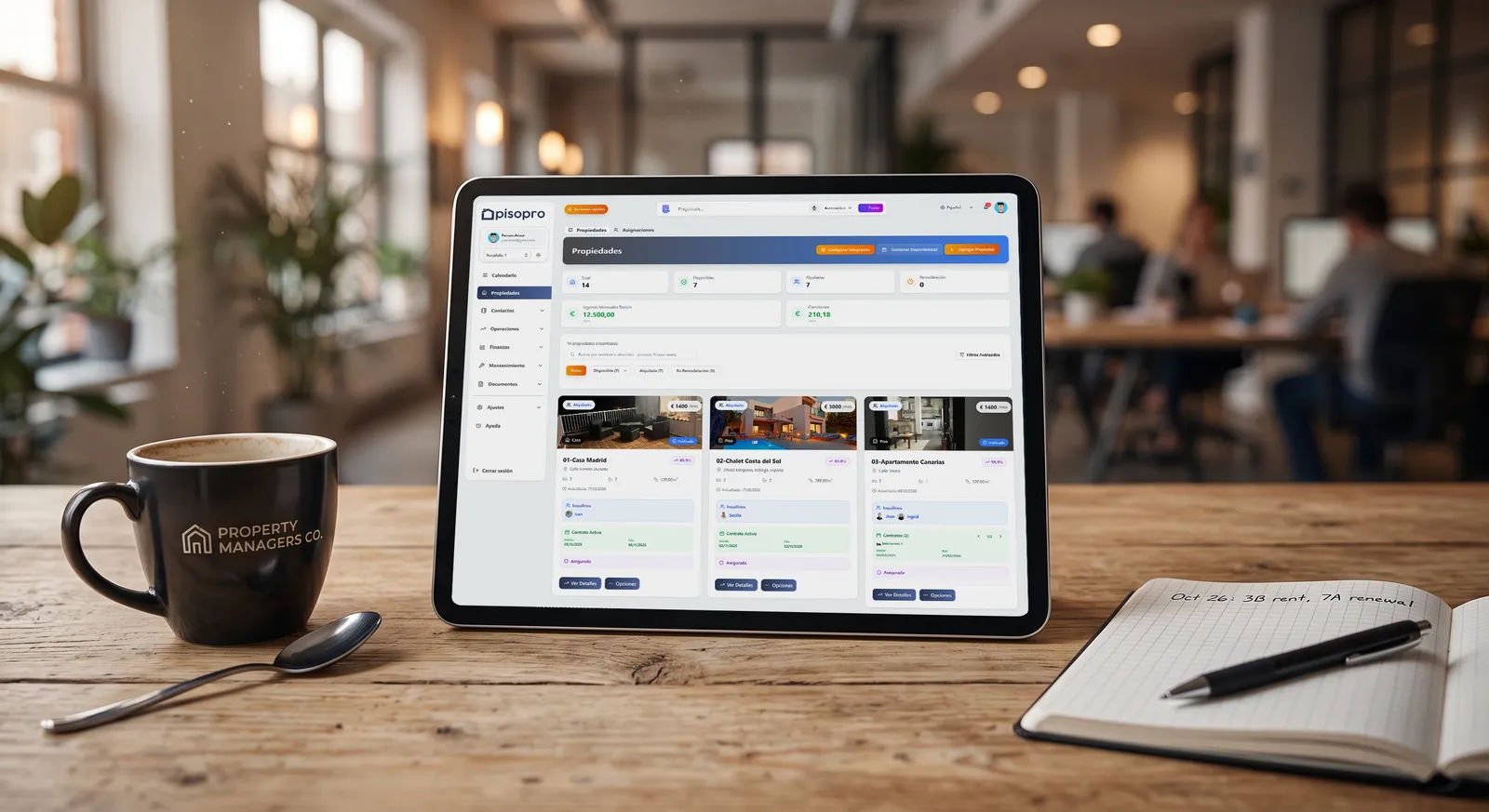
Data from agencies that have digitized their management with tools like pisopro show consistent patterns:
Administrative time: Average reduction of 65-75% in routine management tasks (collections, notifications, documentation).
Capacity per agent: An administrator who could efficiently manage 40-50 properties can handle 80-100 with the same quality level when AI supports management.
Non-payment detection: Average time from collection due date to first notice drops from 5-7 days (periodic manual review) to less than 24 hours (automatic detection).
Owner satisfaction: Agencies implementing automatic portals with periodic reports report a 40-60% increase in owner client retention in the first 12 months.
Management errors: Error rates in documentation, dates, and rent calculations drop practically to zero when the system manages them automatically.
pisopro has not added AI as a marketing layer over conventional management software. Artificial intelligence is integrated into the main workflows from design:
In collections: Automatic real-time non-payment detection, multichannel communication to the tenant with automatic escalation and complete follow-up recording without manual intervention.
In contracts: Configurable expiration alerts with associated automatic actions, rent review calculated and communicated without team intervention.
In incidents: Automatic classification by urgency and category, assignment to the appropriate provider, and owner notification at the correct detail level.
In reports: Automatic generation of settlements and profitability reports for each owner at the close of each period, without the team having to prepare them manually.
In the management agenda: Automatic prioritization of actions requiring human attention, with the context needed for the team to make informed decisions in seconds instead of minutes.
The question is not whether your agency should adopt AI in management. The question is how much it is costing you each month not to have done so yet: in team hours, in errors that become problems, and in properties you could be managing but cannot because your operation does not scale.
If you manage 20 or more properties and feel that administration is growing faster than your capacity to handle it, request a pisopro demo. In 30 minutes we will show you exactly what would be automated in your specific operation.
pisopro is AI-powered software for real estate portfolio management in Spanish agencies. pisopro.com
Keep exploring pisopro: property management software, software for real estate agencies, incident management, financial management, tenant portal and events calendar. You can also book a demo.
Discover how pisopro can help you implement all these strategies and automate your property management.
Request demoSign in with Google to leave a comment
Loading comments...
AI for property management: leads, incidents, Pepe’s end-to-end flow, and what still needs a person.
Real Estate ManagementPractical guide to real estate automation: which processes to automate first, how to measure impact, and what tools actually work in 2026.
Real Estate ManagementThere are two types of real estate agencies in 2026: those that automate and those that still manually do what a system should do for them. The difference is not just efficiency, it is growth capacity. An agency that de