Real Estate Management
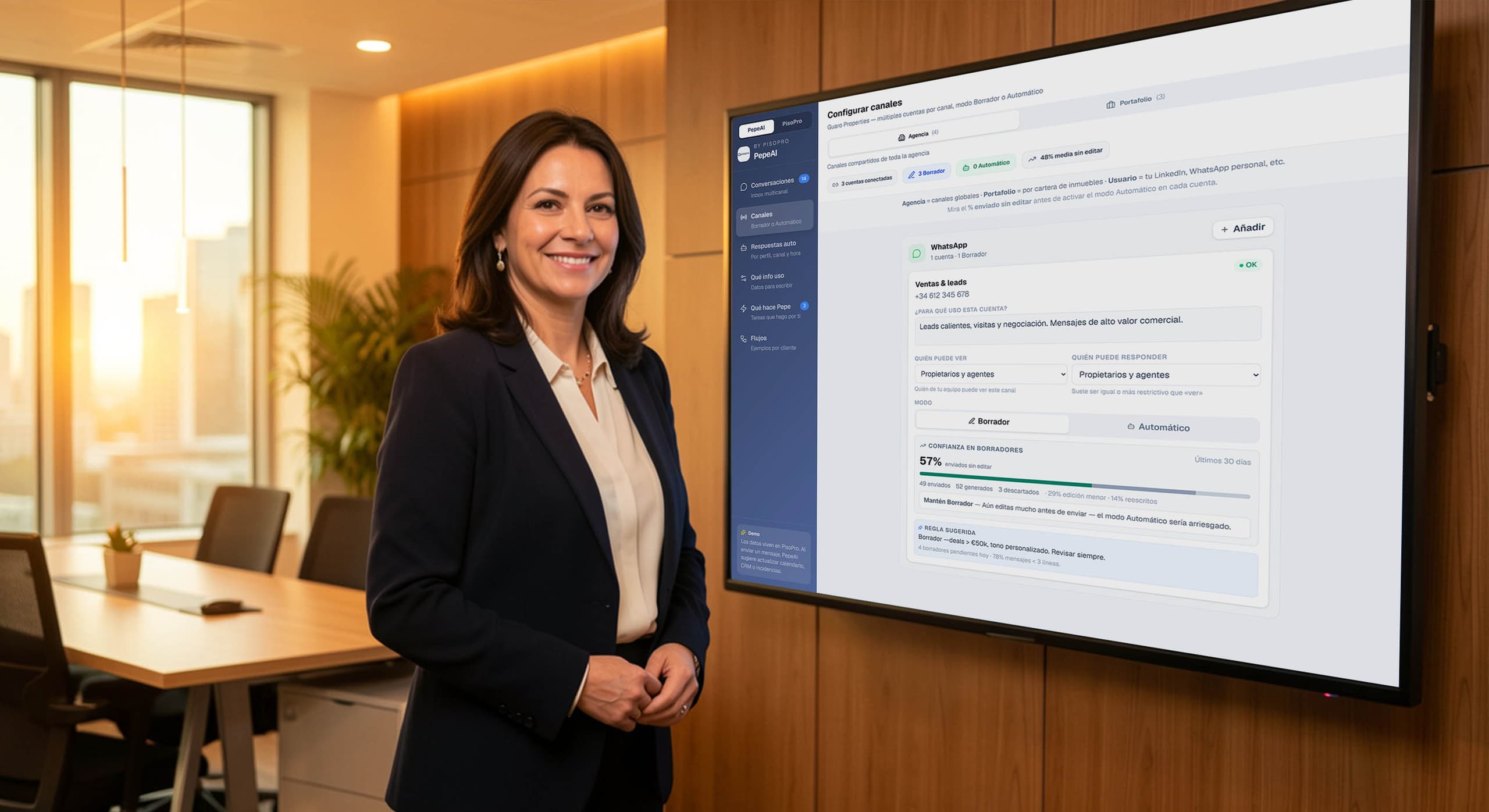
The profit of a property management agency depends on four variables: fee income, personnel costs, overhead costs, and operational losses (undetected non-payments, settlement errors, properties remaining vacant longer than necessary). A well-implemented management system directly influences all of them.
This is the most direct impact and the easiest to quantify. An agency without a digitalized system needs approximately one administrative staff member for every 40–50 managed properties. With a properly configured system and AI automation, that ratio shifts to 80–100 properties per person.
In financial terms: if the total cost of an administrative staff member (salary + social security) is between €28,000 and €35,000 per year, and the system allows you to scale up by 50 more properties without hiring, the savings in marginal labor costs are direct and recurring.
This is not about firing anyone; it’s about not needing to hire the next person until your portfolio is significantly larger.
In manual management, the typical non-payment detection cycle looks like this: payment status is checked the week after it was due, the tenant is called, you wait, and you call again. The average time from non-payment to initial action is usually 5 to 10 days.
With an automated system, detection happens in real time, on the very day the payment fails to arrive. The first notice goes out that same day.
The impact on portfolio delinquency is significant: agencies that automate non-payment detection reduce their delinquency rate by 30–50% simply because they act faster. Every day shortened in the management cycle reduces the likelihood of the situation escalating into an eviction process.
When a tenant leaves a property, there is a vacant period before the next one moves in. That period carries a direct cost: uncollected rent, ongoing overhead expenses, and team time spent on turnover.
A system that monitors expiration dates and alerts you well in advance allows the agency to start searching for the next tenant before the current one leaves, rather than starting once the property is already empty.
The difference between managing the process 60 days in advance versus 7 days in advance easily saves 2 to 4 weeks of vacancy per property. In a 100-property portfolio with a 20% annual turnover rate, that equals 20 contracts per year with 2–4 weeks of avoided uncollected rent per contract.
Owner churn is one of the biggest hidden costs for agencies. When an owner leaves, you don't just lose the fees from their portfolio; you also lose the acquisition effort and cost invested to win them as a client in the first place.
Agencies with systems featuring an owner portal and automated reporting retain their clients significantly better. The reason is simple: an owner who can check the status of their properties, collections, and expenses at any time has no reason to think the agency is withholding information or doing a half-hearted job.
The transparency offered by a good system is one of the most powerful loyalty drivers an agency can have, and once set up, it requires zero additional effort from the team.
This is the most strategic impact. An agency operating with efficient systems can add 30, 50, or 100 properties to its portfolio without scaling up staff in the same proportion. Consequently, the margin per additional property is much higher than that of the initial ones.
This creates a leverage effect: the first properties in your portfolio cover overhead costs, while those added after proper digitalization go straight to the bottom line. It’s the difference between a business growing linearly and one growing exponentially in profitability.

Until recently, automation in property management mostly relied on fixed rules: if X happens, do Y. Useful, but limited. AI has radically changed that landscape.
What distinguishes a system with real AI from one with basic automation is the ability to handle unpredictable situations, which represent the majority of daily real estate operations.
AI-Powered WhatsApp Incident Management: A tenant sends a 30-second voice note describing a bathroom issue. A basic system wouldn't know what to do with it. An AI-powered system transcribes the message, identifies it as a medium-urgency plumbing issue, creates a ticket with tenant and property details, and notifies the agency’s plumber. The manager doesn't need to step in until it's time to approve the quote.
Automated Lead Qualification: A prospect reaches out at 11:00 PM about an apartment listing. An AI system responds immediately, asks key screening questions (budget, location, move-in date, number of occupants), creates a lead profile, and assigns it to the sales agent with notes ready for a call the next morning. The agency secures the lead before the prospect even has time to contact the competition.
Automated Rent Reviews: Every year, contracts tied to inflation (CPI) must be updated. The system handles this autonomously: it calculates the new rate, generates the communication to the tenant, updates the contract, and schedules the charge with the new amount, without anyone in the agency needing to remember to do it.
The impact of these capabilities on profit is twofold: it reduces operational costs and increases revenue (fewer lost leads, better owner retention, and more properties managed per employee).
Here is a simple exercise you can run on your own operation:
System Cost: Typically between €100 and €300 per month for a mid-sized agency, depending on the provider and portfolio size.
Estimated Labor Savings: If the system saves you 10 hours per week of administrative work (a conservative estimate for a 50-property portfolio) at an hourly cost of €15, the monthly savings equal €600.
Avoided Non-Payments: If automated detection reduces your delinquency rate by 30% and 5% of your portfolio currently has an active non-payment process, savings in management time and faster recovered rent can easily amount to hundreds of euros per month.
Avoided Vacancy Costs: If proactive lease expiration management saves you 2 weeks of vacancy across 10 annual contracts with an average monthly rent of €800, the annual benefit is an additional €4,000.
For a 50-property agency, the sum of these three factors far exceeds the cost of the system, even before factoring in the financial impact of higher owner retention and scalable portfolio growth.

When trying to digitalize without committing to an end-to-end system, many agencies end up with a piecemeal collection of tools that don't communicate with each other: a CRM for contacts, Google Drive for documents, a payment app for billing, and personal WhatsApp accounts for communication.
This "patchwork" carries massive hidden costs: lost time moving data between platforms, errors due to outdated information, and an inability to get a consolidated view of the business.
The system that maximizes profit isn't necessarily the most complex or expensive; it’s the one that best centralizes information and automates your most time-consuming workflows. And that needs to be one single system, not four.
Property management systems are not a tech expense; they are one of the most direct levers for improving an agency's profit margins. They reduce costs, boost revenue, enhance client retention, and unlock scalable growth without proportional overhead increases.
The real estate sector is at a tipping point: agencies investing in systems and AI are building an operational advantage that will become increasingly difficult for manual competitors to match. The gap is widening every day.
Discover how pisopro can help you implement all these strategies and automate your property management.
Request demoSign in with Google to leave a comment
Loading comments...
Decision guide: what software for real estate agencies must include, who it is for, which modules matter, and when switching pays off.
Real Estate ManagementAI for property management: leads, incidents, Pepe’s end-to-end flow, and what still needs a person.
Real Estate ManagementReal estate CRM for agencies and rentals: lead-to-close flow, generic CRM vs operations, and how it looks in pisopro.