Real Estate Management

Anyone can rent out an apartment. Managing rentals is another story. It's coordinating the tenant, owner, bank, suppliers, tax agency, and public administration without any of the five getting mad at you in the same month. And doing it with a margin.
This guide is for those who manage rentals as a business or as a large personal portfolio. We are not going to explain what a deposit is or recommend notary paperwork. We go straight to the real operational cycle, step by step, with the traps that appear when you have passed a certain scale.
1. What rental management actually includes
2. The life cycle of a well-managed rental
3. Legal and tax obligations you cannot skip
4. The 5 tasks that eat up the manager's time
5. When to stop managing manually
6. What nobody tells you: managing 30 rentals well is more profitable than 100 poorly
7. Frequently Asked Questions
8. Next Step
If you had to list everything a professional rental manager does in any given week, the list would surprise you. Beyond "renting apartments" there is invisible work that defines the difference between profitability and bleeding money.
Rental management includes, at a minimum:
And that's if everything goes well. When there is a default, damage to the property, neighborhood conflict, or legal claim, the list doubles.
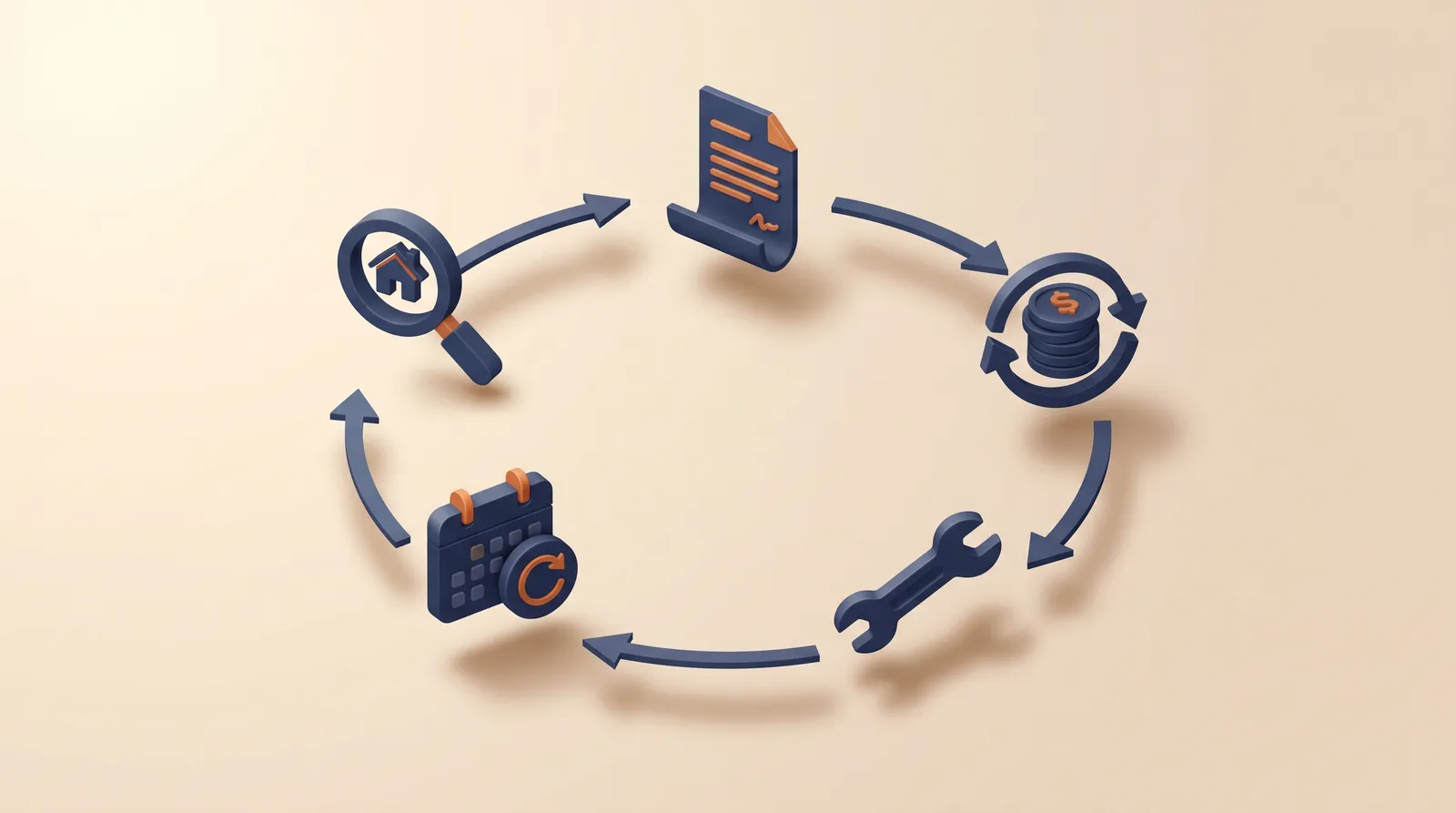
Thinking in phases helps not to lose things along the way. These are the five phases of the life cycle of any rental.
Publication on portals (Idealista, Fotocasa, Pisos.com), reception of leads, filtering, visits, request for documentation (ID, employment contract, payrolls, employment history, previous references), solvency evaluation.
Sign that you are doing it manually when you shouldn't: you spend more than 30 minutes per candidate collecting and reviewing documentation.
Generation of the contract from a template, electronic or face-to-face signature, deposit of the bond by the tenant, deposit of the bond before the corresponding regional body (IVIMA in Madrid, INCASÒL in Catalonia, etc.), delivery of keys, registration of supplies.
Sign that you are doing it manually when you shouldn't: you use different Word templates depending on the property or owner and fill out each contract by hand.
Monthly collection of rent, registration of income, bank reconciliation, issuance of invoice/receipt if applicable, liquidation to the owner (deducting commissions and passed-on expenses).
Sign that you are doing it manually when you shouldn't: your bank reconciliation is exporting the statement and matching it by hand against the list of tenants.
The tenant reports a breakdown. You classify it (urgent, normal, decorative, tenant's responsibility vs owner's), look for a supplier, authorize, supervise, receive the invoice, decide who pays, pass it on to the owner or assume the cost according to the management contract.
Sign that you are doing it manually when you shouldn't: you have open incidents that you don't remember what state they are in without having to open 3 WhatsApp chats.
Expiration of the contract. Decide whether to renew, not renew, raise the price (based on what criteria: IPC, market, investment made), communicate with legal time to tenant and owner, manage tacit extensions if applicable, organize the departure if they leave (property inspection, return of deposit, cancellation of supplies).
Sign that you are doing it manually when you shouldn't: you find out about the expiration of a contract because the tenant or owner reminds you.
This is not legal advice, ask your lawyer for that. But there are obligations that no professional manager can ignore.
Urban Leasing Law (LAU). Defines the minimum duration of contracts for a habitual residence (5 or 7 years depending on whether the landlord is a natural or legal person), tacit extensions, conditions for updating the price, causes for resolution. Knowing it in detail is mandatory.
Deposit of bond. In each autonomous community, there is a body where the deposit must be deposited. Not depositing it is a penalty.
Certificate of habitability and energy certificate. Mandatory to rent. The administration asks for them in inspections.
Model 180 and Model 100. The owner pays taxes on the rental income in their personal income tax (IRPF). If you manage for third parties, you provide them with the information for their declaration.
Model 210 for non-residents. If the owner is a non-resident foreigner, there is a specific withholding to apply.
Housing Law 12/2023. Regulation of stressed areas with limitations on increases, changes in contract duration, regulation of new leases. Changes frequently and by community.
Verifactu and TicketBAI. Mandatory electronic invoicing system in the Basque Country (TicketBAI) and soon national (Verifactu). If you issue invoices for management, it affects you.
GDPR. You handle tenants' personal data. You must have a privacy policy, consent, and procedures for deletion.

When we ask property managers where their time goes, the answer is always the same. And the answer says a lot about what to automate first.
1. Bank reconciliation. Matching bank movements with expected collections from tenants. 4-6 hours a week in a portfolio of 50-80 properties without automation.
2. Incident management via WhatsApp. Receive, classify, assign, follow up, close. Without a system, an incident can have 30 messages spread across 4 different chats.
That cycle (24/7 intake, classification, photos, vendor, follow-up, and close) is pisopro’s property incident management, with Pepe Maintenance answering the tenant.
3. Monthly reports to the owner. Manually build the monthly summary of income, expenses, balance, and comments. 30-45 minutes per owner.
4. Reminders and expirations. Remembering contract expirations, IPC increases, insurance renewals, appointments with the administration. Without a system, this lives on mental post-its and falls through.
5. Scattered documentation. Search for the signed contract of a specific tenant. Search for the latest community invoice for a property. If your archive is Drive without structure plus Gmail, it's 5-10 minutes per query.
Total: a person in a portfolio of 80 properties spends between 15 and 20 hours a week on these five tasks. It is exactly half of their working day. And they are the five tasks that have the most and best automation available today.
There is no universal answer, but there are three practical thresholds.
Up to 10-15 properties: Excel and well-organized Google Drive are enough. You manage with your head, you remember tenants by name, expirations are on the calendar.
Between 15 and 30 properties: Excel starts to fail. You miss expirations, mix up contracts, reports to owners cost you too much. Time to start evaluating software, not necessarily migrating right away.
Above 30 properties: Excel and WhatsApp do not scale. You will start making mistakes that cost money (deposits not deposited on time, contracts not renewed, un-reconciled collections). The software pays for itself in avoided errors, even before hours saved.
There is a fourth mental threshold that most do not contemplate: Do you want to grow? If your intention is to stabilize at 50 properties, the migration threshold is more relaxed. If your intention is to reach 200 in 18 months, it is better to migrate earlier and grow on top of the new tool.

This is an uncomfortable conversation with many managers who have grown faster than their operational capacity.
The profitability of a rental is not determined solely by the price you charge. It is determined by the hidden costs of management: a deposit not deposited that ends up in a penalty, a non-renewed contract that causes a departure, poorly managed maintenance that damages the home, a dissatisfied owner who changes management. These costs rarely appear on the P&L but are real.
The more volume, the more errors. The curve is not linear. 100 poorly managed properties can generate less net margin than 30 well-managed ones, because each error costs more than the marginal income of the property that causes it.
The practical conclusion: before capturing more, professionalize the management of what you already have. And when you capture more, do it on top of a system that can withstand the growth.
Is managing tourist rentals the same as long-term ones?
No. The regulation (licenses, tourist tax, regional regulations), the type of relationship with the tenant (guest vs lessee), the taxation (VAT in tourist, not in long-term), the platforms (Booking, Airbnb vs traditional portals) and the operational flows (check-in, cleaning) change. They are different businesses with different software.
How much does a rental agency charge to administer third-party apartments?
The usual range in Spain is 6-10% of the rent collected for integral management. Specific fees are added for tenant recruitment (usually one monthly payment), major incident management, or intervention in conflicts. Each agency has its model.
Who pays for breakdowns, the tenant or the owner?
It depends on the nature of the breakdown. The LAU regulates that the lessor (owner) assumes the necessary repairs to preserve habitability. The lessee assumes the small repairs derived from ordinary use and the damages caused by misuse. The management company usually classifies the incident and applies criteria.
How do I manage a rent default?
Immediate communication via a certified channel, regularization plan if there is a willingness to pay, legal claim if there is not. The LAU allows eviction for non-payment with specific procedures. It is one of those times when default insurance proves its worth.
Do I need a license to manage third-party rentals?
It depends. The management of urban estates as a collegiate administrator has its own framework. Real estate intermediation as an AICAT agent (Catalonia) or regional registry has another. And the simple management of rentals for a relative or friend does not require registration. Check with your autonomous community.
If you recognize three or more of the symptoms we've described, reconciliation eating up your mornings, WhatsApp incidents getting lost, owners asking for reports that take you time to build, expirations slipping away, manual management is already costing you more than you save.
Try it on pisopro. Schedule a 20-minute demo and we'll show you how we automate the 5 tasks that take up most of your time: bank reconciliation, incidents classified with AI, one-click owner reports, expiration reminders, and centralized documentation. With your real portfolio, not with mockups.
Keep exploring pisopro: property management software, software for real estate agencies, incident management, financial management, tenant portal and events calendar. property and rental management software. You can also book a demo.
Discover how pisopro can help you implement all these strategies and automate your property management.
Request demoSign in with Google to leave a comment
Loading comments...
Learn when spreadsheets are still valid, which signals mean you need software, and how to compare options without wasting time. A practical guide for landlords and managers.
Real Estate ManagementDecision guide: what software for real estate agencies must include, who it is for, which modules matter, and when switching pays off.
Real Estate ManagementAI for property management: leads, incidents, Pepe’s end-to-end flow, and what still needs a person.