Real Estate Management

Property and rental management software —also searched as property administration software— exists to centralize a portfolio: contracts, collections, incidents, vendors, documents, communications, and reporting. It is not an agency’s lead-gen CRM.
This page is for portfolio owners and property managers. If your day is the sales pipeline (leads, visits, portals), use the software for real estate agencies guide. Here the job is different: run rentals without Excel, WhatsApp, and five tabs per owner.
When you finish, you will have criteria by module and by portfolio size (20, 50, 100, or 500+ units), not a “top 10” ranking.
1. What is property management software (and what it is not)
2. What property administration software must cover
3. The 6 essential modules for 2026
4. The 3 features that set the good apart from the average
5. How to evaluate your portfolio before choosing software
6. What you need by portfolio size
7. Frequent errors when migrating from Excel + WhatsApp
8. What nobody tells you: real ROI isn't about time savings
9. Frequently Asked Questions
10. Where to start
Property management software is a platform that centralizes the complete life cycle of a rental portfolio: properties, owners, tenants, contracts, collections, incidents, and reporting. It is the operating system for a professional manager.
It is not a CRM for lead generation. It is not a spreadsheet in the cloud. It is not a generic ERP with a real estate module tacked on. If your tool doesn't understand what a security deposit, a lease extension, or a bank reconciliation per tenant is, it's not property management software; it's just software where you've put property data.
The difference lies in who is building the software. The serious tools on the market are made by teams who understand the actual operations of managing 100, 500, or 5,000 properties. The average ones are made by teams who have seen a property Excel sheet and thought, "this can be digitized."
If you own or manage a portfolio, the software must run the rental, not the sales funnel. These seven blocks are the minimum to centralize property and rental management:
If one is missing, you will open another tool and return to a fragmented stack. The modules below turn each block into a quality signal.
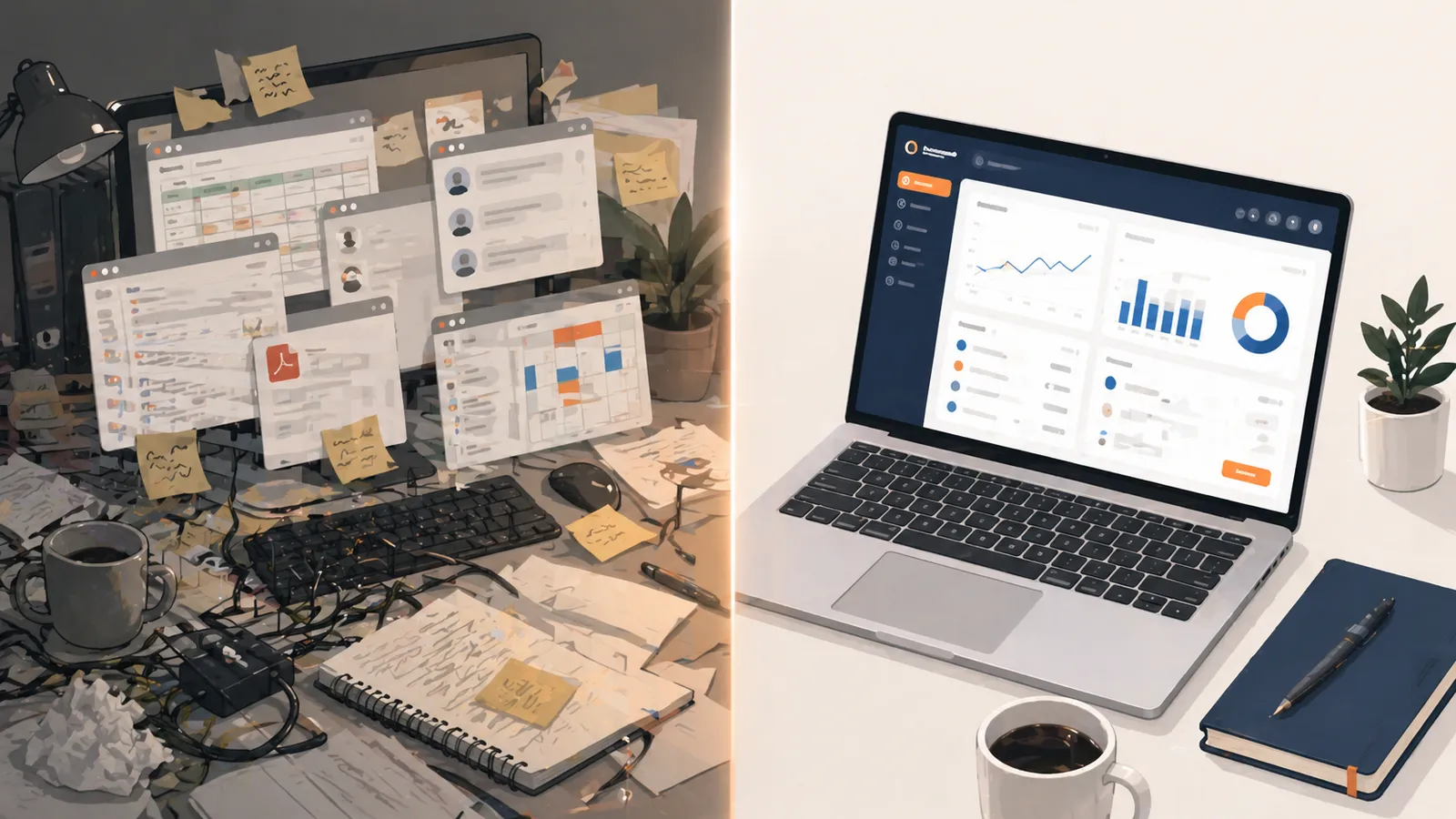
Any property management software worth its salt must cover these six blocks. If one is missing, you'll end up opening another tool to fill the gap, and you're back to the fragmented stack you wanted to escape.
The base module. Each property must have a complete profile: address, features, photos, documentation, associated owner, status (rented, vacant, under renovation), and units (if there is a subdivision by rooms, for example, in coliving or studios).
The quality signal: when you filter "vacant 2-bedroom properties in downtown Madrid," it takes less than a second. If it takes longer, the software has a poorly designed data structure.
Three types of contacts that have different rules. The owner wants monthly reports and transparency. The tenant wants a quick response to incidents. The prospect wants to see availability and book.
Good software doesn't mix them into a single generic contact; it models them with different fields, permissions, and flows. If you open your CRM and see "contacts" without distinction, you're on the wrong track.
This is where the wheat is separated from the chaff. Serious software gives you profit and loss per property, not just an aggregate of the entire portfolio. Why it matters: because the owner asks you how much their flat is yielding, not how much your business is yielding.
What it must do well:
Contract generation from templates, electronic signature, custody, expiration alerts, tacit extensions, inflation adjustments. And a documentary archive per property: photos, deeds, energy certificates, building inspections.
What rarely works well: the integration between the signed contract, property, tenant, and collection schedule. If you sign a contract and have to manually create the payments in another module, your software is just a collection of tabs, not a platform.
The tenant reports a breakdown. The manager classifies it. Assigns a vendor. Follows up. Closes. Bills the owner or assumes the cost. Notifies.
Handmade via WhatsApp with 50 properties: nightmare. Made with well-designed software: the tenant reports from an app or portal, the system classifies by type (plumbing, electricity, appliances) using AI, routes to the usual vendor, warns you of legal deadlines, and leaves a trail for claims.
Dashboards for occupancy, profitability, delinquency, open incidents, upcoming expirations. Not for decoration, but for making portfolio decisions.
And external reports: the report you send to the owner each month with their income, expenses, balance, and comments. If your software doesn't generate it with one click, you'll continue doing it in Word.
Almost all software on the market covers the previous 6 modules with more or less proficiency. What separates the good from the average lies elsewhere.
The sector is saturated with "revolutionary AI" that is just a chatbot glued on top of the product. Real AI is embedded in the flows: it classifies incidents automatically, extracts data from a PDF contract you upload, proposes categories when reconciling a bank movement, and drafts the monthly summary for the owner.
How to distinguish it: if the AI is a separate button called "AI Assistant," it's probably decorative. If the AI is inside each module doing invisible work, it's real.
We repeat because it matters. Most software gives you finances at the portfolio level and a global balance. That serves your accountant, not you or your owner.
A well-constructed P&L per property tells you: this apartment of yours in Chamberí earned €18,000 in 2025, spent €4,200 on community fees, property tax, two repairs, and insurance, and had one month of vacancy. Net yield: X%. That conversation with the owner changes the relationship.
English-centric software poorly translated versus software made for your market. Specific differences: local tenancy laws, tax applications (VAT/IRPF) for long-term vs short-term rentals, synchronization with local banks, and integration with local property portals.
If your software was designed in San Francisco and sold as a translation, you'll face legal and operational frictions that will cost you dearly.
Before requesting demos, answer six questions honestly. They will save you weeks of evaluation and months of regret.
1. How many properties do you manage today and how many in 2 years? Software for 30 properties and software for 300 are different products. Buy for your goal, not your current situation.
2. What percentage of your portfolio is long-term rental vs. short-term/tourist? This radically changes the functions you need (channel management vs. lease management).
3. Do you manage third-party properties, your own, or a mix? If you manage for third parties, you need owner reporting and strict accounting separation.
4. How much time does your team spend on administrative tasks that don't add value? Reconciliation, reminders, generating reports. Measure hours/week before you start.
5. What tools do you use today and what specific problem does each one cause? It's not the same to migrate from Excel as it is from a fragmented stack of apps. The more fragmented, the more urgent the centralization.
6. What would you do tomorrow if you had 4 more hours in the day? This is the best question to know which software module to prioritize when evaluating.
The same software does not fit 20 units and 500. Use these thresholds so you do not buy too much or too little.
Excel and Drive can hold if one person knows every contract. Software starts to pay when several owners appear, incidents get lost, or a collection will not reconcile. Prioritize contracts, collections, and documents — not a sales CRM.
WhatsApp stops being a system. You need incidents with a vendor, reconciliation, and an owner report that does not eat an afternoon. This is the size where most portfolio managers actually migrate.
Without a platform, quality drops: expiries, deposits, and unpaid rent slip. You need P&L per property, traceable communications, and two people working the same portfolio without stepping on each other.
The bottleneck is operations and integrations: banking, roles, investor reporting, and automation. Property administration software must hold volume without each unit living in someone’s head.

Yes, you will migrate. And yes, it will hurt for 4-6 weeks. These are the errors we see repeatedly.
Wanting to migrate all historical data on day one. No. Migrate the live data (active properties, current contracts, current contacts) and enter the history in a block at the end. If you paralyze operations to migrate 5 years of WhatsApp, you fail.
Not training the team before releasing the tool. Software is not "intuitive." 2 hours of well-done onboarding are worth 20 hours of support later.
Keeping Excel "just in case." If you leave Excel running in parallel, half the team will continue using it. Clean decision: from day X, only the software is used. Excel is archived.
Choosing by price instead of fit. A cheaper tool that doesn't fit your operations is very expensive in lost hours. Price is the last criterion, not the first.
Not measuring the before and after. If you don't know how many hours your team spent on bank reconciliation before the software, you won't be able to defend the investment when the CFO asks for ROI.
The most common sales pitch for property management software is "it saves you X hours a week." That's true. But it's not the main ROI.
The real ROI is in three places that almost no one quantifies:
Errors you stop making. A security deposit not returned on time is a penalty. A contract not renewed is an exit. A poorly reconciled collection is an angry owner. Software doesn't just save time; it prevents errors that were costing you invisible money.
Portfolio capacity you gain. With Excel and WhatsApp, you manage 50 properties well. After 80, the quality drops. With serious software, one person manages 150-200 with the same quality. The ROI is the growth you couldn't assume before.
Higher quality conversations with owners. When you can send a professional P&L to the owner every month, the conversation changes. They renew. They bring their cousin. They refer. Software doesn't make you a better manager, it makes you look like a better manager.
If you're going to evaluate tools, calculate these three ROIs before time saved. You'll make better decisions.
How much does property management software cost?
The market range goes from €30 to €200 per user per month, with large variations according to features, number of properties, and support. Free options are usually limited or have a hidden cost per transaction.
Is it worth it for a small portfolio?
Below 10-15 properties, probably not. Excel works. Between 15 and 30, it depends on your model. Above 30, the software pays for itself in avoided errors and recovered hours.
Can I use a generic CRM like HubSpot or Salesforce?
You can. You'll reinvent the wheel for 6 months building custom objects, automations, and reports. When you finish, you'll have something halfway between a CRM and real estate software, worse in both dimensions. Better to start with vertical software.
If you manage 30 or more properties and recognize three or more of the symptoms we've described, the logical next step is to see software in action with your own data, not with mockups.
Try it on pisopro. Schedule a 20-minute demo and we'll show you exactly what managing your real portfolio looks like on pisopro.
Keep exploring pisopro: property management software, software for real estate agencies, incident management, financial management, tenant portal and events calendar. You can also book a demo.
Discover how pisopro can help you implement all these strategies and automate your property management.
Request demoSign in with Google to leave a comment
Loading comments...
Discover the 4 types of real estate software in Spain and how to choose the right one for your profile. 2026 guide with types, modules, and key integrations.
Real Estate ManagementDecision guide: what software for real estate agencies must include, who it is for, which modules matter, and when switching pays off.
Real Estate ManagementAI for property management: leads, incidents, Pepe’s end-to-end flow, and what still needs a person.