Real Estate Management

"Real estate software" is one of those terms that everyone uses and almost no one defines the same way. For an agency selling apartments, real estate software is a CRM with connection to Idealista. For a rental portfolio manager, it is an operations platform with P&L per property. For a property administrator, it is a homeowners' association program. All three are true. And they are three completely different products.
It is also searched as a property management program: same question. This URL is the category map. If you already run an agency, use the software for real estate agencies guide. If you run a portfolio, use property and rental management software.
This guide is a map of the territory. It won't sell you a tool, it will help you understand which category of real estate software you fit into before you ask for demos. If you run an agency, the software for real estate agencies guide turns that into a checklist of modules and when to switch. For AI, CRM, and incidents: AI for property management, real estate CRM for agencies and rentals, and rental property incidents. Because the worst decision is buying the most popular software instead of the most appropriate one.
1. What we mean by real estate software (and why the question matters)
2. The 4 types of real estate software coexisting in the market
3. Which one you need according to your profile
4. The underlying change: from record-keeping software to AI software
5. Integrations that matter (and those that just sound good)
6. What nobody tells you: "all-in-one" is marketing, not technical reality
7. Frequently asked questions
8. Next steps
Real estate software is any platform designed to manage one or several processes of the real estate business: acquisition, marketing, portfolio management, property administration, investment, valuation. This broad definition is useful for Google. It is not useful for your purchasing decision.
The operational question is different: which real estate business process do you want to digitize? Because each process has its vertical software, and when you try to solve two processes with a single tool, you usually end up with a tool that is mediocre at both.
There is a second important question: with what level of depth? There is software that superficially covers the entire cycle and software that delves deep into one phase. Knowing what type you need is the preliminary filter to any comparison.

Here is the classification almost no one makes, saving you 70% of the evaluation work.
Designed for agents who acquire properties and sell or rent them. Its core is the commercial pipeline: leads, properties in portfolio, viewings, offers, closings.
Typical features: integration with portals (Idealista, Fotocasa, Pisos.com), mass publishing, lead management, viewing calendar, opportunity tracking, exclusive and mandate signing.
What it does well: agency focusing on sales or acquisition rentals. The main user is the commercial agent.
Where it falls short: post-sale or post-rental management. When the contract is signed, the tenant enters the system and the real lifecycle begins, acquisition CRMs stop there.
Designed to manage the complete rental lifecycle: properties, owners, tenants, contracts, collections, incidents, reporting. They start where the acquisition CRM ends.
Typical features: property profile, lease contract management, bank reconciliation, P&L per property, maintenance, owner reports, document management.
What it does well: agency or manager with a stable portfolio of rentals under management, their own or third-party. The main user is the property manager.
Where it falls short: if your business is pure acquisition without post-signing management, this software is overkill. If you manage homeowners' associations, this isn't it.
This is where pisopro comes in, along with other market options.
Designed for collegiate urban property administrators dealing with homeowners' associations, special assessments, meetings, community budgets.
Typical features: community management, community receipts, community accounting, meetings, minutes, special assessments, debtors.
What it does well: collegiate property administrators with a portfolio of communities.
Where it falls short: individual rental management. Common confusion, because "fincas" (estates/properties) is also used colloquially for rentals, many people think property administration software works for managing rented apartments. It is not the same.
Platforms that promise to cover acquisition + management + communication + finances in a single tool. They sound ideal on paper.
Typical features: a simplified version of all the above, focusing on a unified experience.
What it does well: small structures (1-3 people, under 50 properties) where simplicity outweighs depth.
Where it falls short: when you grow. The "all-in-one" promise usually means "average at everything". Beyond a certain size, you'll have an all-in-one module that isn't enough and another you don't need.
Now the translation to your real situation.
What you need: an acquisition CRM with portal publishing, basic lead management, and calendar. You can still handle post-signing management in Excel, it still fits.
What you DO NOT need: real estate ERP, advanced portfolio management software, P&L modules per property. It would be spending on complexity you don't use.
Probable future bottleneck: when you pass 30, the Excel for post-signing management will start to fail.
What you need: rental portfolio management software with modules for properties, contracts, collections, maintenance, and reporting. If you also actively acquire, consider whether you combine it with an acquisition CRM or if your management software covers the minimum.
What you probably DO NOT need: a complete real estate ERP. Unless you also manage communities.
Probable future bottleneck: integrations with your bank and external portals.
What you need: serious portfolio management software with automatic bank reconciliation, P&L per property, AI for incident classification, and automated processes. Professional owner reporting is now an operational necessity, not a luxury.
What you probably DO NOT need: an acquisition CRM if your main business is management, not new acquisition. Though it can coexist as a secondary tool.
Probable future bottleneck: team capacity. At this size, without automation, one person manages fewer properties than they could.
What you need: enterprise portfolio management software with APIs, advanced automations, flow-applied AI, integrations with external accounting systems (NetSuite, Holded), and advanced investor reporting. The tax and financial aspect begins to outweigh the purely operational one.
Probable bottleneck: integration with your accounting and financial stack is the bottleneck, not the management software itself.

The most relevant difference in the real estate software market in 2026 is not of type, it is of generation.
First-generation software (2005-2015): record-keeping systems. They serve to save structured information. You do the work, the software saves it. Databases with an interface.
Second-generation software (2015-2022): process systems. They automate flows: notifications, reminders, integrations, report generation. You design the flow, the software executes it.
Third-generation software (2023-2026): systems with flow-applied AI. They do cognitive work that previously only humans did: classify incidents, extract data from a PDF, reconcile collections, draft summaries, suggest expense categories. You supervise, the software proposes.
Most of the real estate software you will see in demos in 2026 is second-generation with a chatbot pasted on top that they call AI. True third-generation is still a minority and it shows because the AI is inside each module, not in a separate tab.
If you are going to invest in software today, make sure the tool's DNA is third-generation, not second with makeup.
When they list integrations, there are three categories. Distinguish them.
Integrations that matter daily:
Integrations that sound good and are rarely used:
Critical integrations most don't highlight but matter:
Before the demo, make a list of the 5 tools you already use that the real estate software has to touch. If the tool doesn't integrate with your bank, your electronic signature, or your accounting system, you will have daily friction.
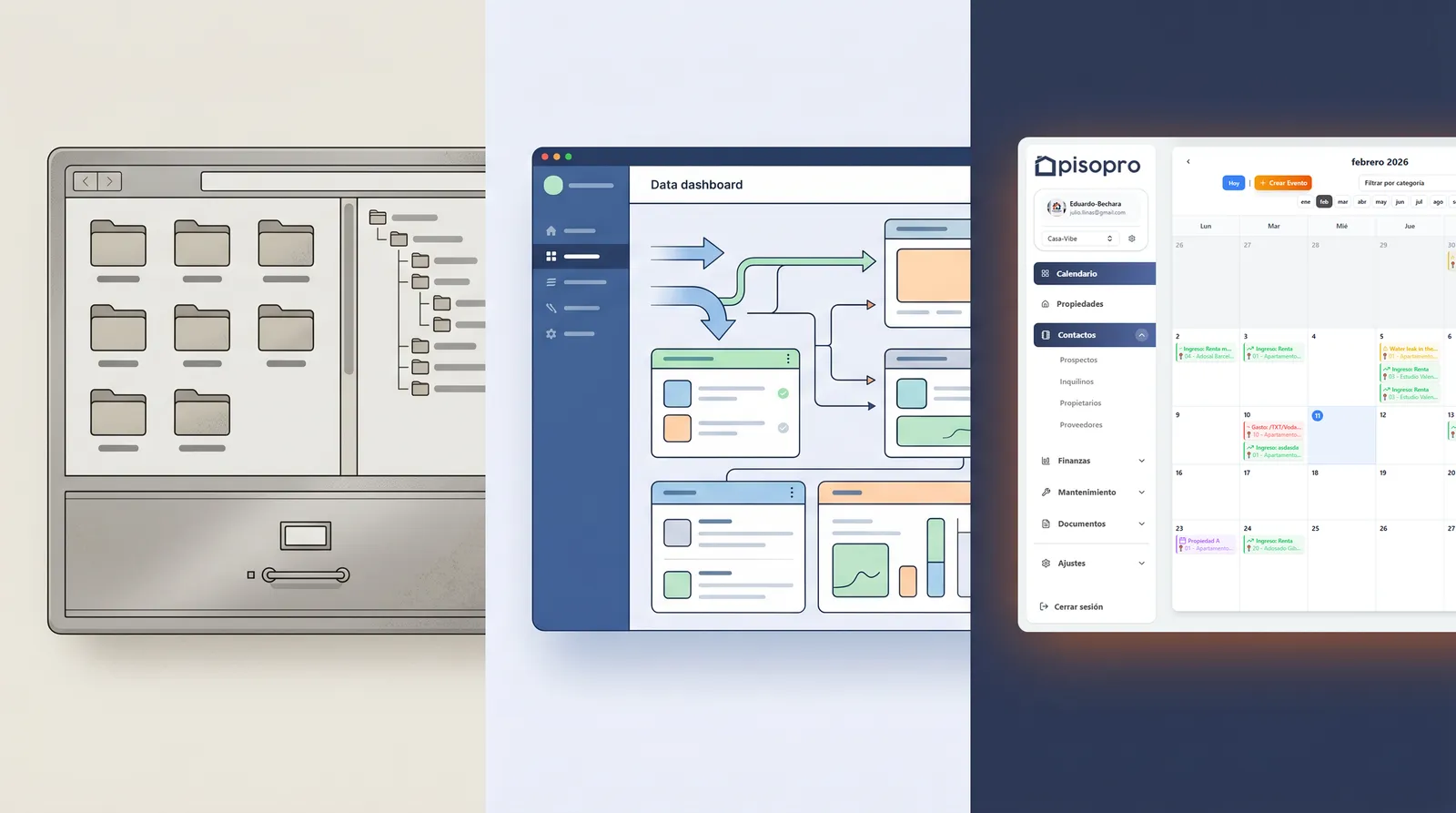
The "all-in-one" concept is one of the most sold and least fulfilled in the real estate software market.
The technical reality: no product team can maintain an acquisition module, a management module, a communities module, a marketing module, and a reporting module at the same level of excellence. Each requires specialization. When a tool claims to cover everything, it usually covers one thing well and the rest basically.
The market has realized this, and the trend is no longer "all-in-one" but "best-of-breed with good integrations". That is: a specialized tool per process, connected to each other. Your acquisition CRM talks to your management software, which talks to your accounting system.
When does an all-in-one make sense then? When the structure is very small (1-3 people, < 50 properties) and the friction of managing several tools outweighs the lack of depth of each module. Above that size, a specialized stack almost always performs better.
The question you must ask in any demo: "which is the module you are best at and which is the newest or weakest?". If the salesperson answers "they are all at the same level", they are lying or don't know the product.
What is the best real estate software in Spain?
It depends on the process you need to digitize. For acquisition, there are specialized options. For rental management, there are others. For property administration, different ones. The question "best real estate software" without more context is like asking "best car": it depends on what for.
Is there free real estate software that works professionally?
Free options are usually limited in number of properties, users, or key features. For professional use with more than 30 properties, it is rare to find something free that holds up. As a test, freemium works; as a stable operational tool, almost never.
Should real estate software be in the cloud or local?
In 2026 practically all serious offerings are SaaS in the cloud. Inherited local options still exist in some traditional offices but fall outside the sector's modernization. Cloud gives you accessibility, automatic updates, and native backup.
How long does a migration to new real estate software take?
From 2 to 8 weeks depending on data volume, number of properties, quality of previous data, and team availability. More important than the total duration: the parallel phase between the old and new system must be minimized to avoid duplicating work.
Is it safe to have my real estate data in the cloud?
Any serious provider must comply with GDPR, have security certification, and redundant backups. Ask specifically: where is the data hosted?, how is it encrypted?, what is the availability SLA?, what is the export policy if I terminate?. If the answers are vague, bad sign.
If you made it here, you already have the initial filter: you know which real estate software category you fit into. The next step is to see real tools with your own questions ready, not with the salesperson's list.
If your profile is rental portfolio management (own or third-party managed properties, complete tenant lifecycle, owners to report to, finances to balance) pisopro is exactly in that category. Third-generation software with embedded AI, native P&L per property, adapted to the local market.
Try it on pisopro. Schedule a 20-minute demo and we'll show you what managing a real rental portfolio looks like with software designed for that case, not with generic mockups.
Keep exploring pisopro: property management software, incident management, financial management, tenant portal and events calendar. You can also book a demo.
Discover how pisopro can help you implement all these strategies and automate your property management.
Request demoSign in with Google to leave a comment
Loading comments...
Property and rental management software for owners and managers: contracts, collections, incidents, and reporting by portfolio size.
Real Estate ManagementDecision guide: what software for real estate agencies must include, who it is for, which modules matter, and when switching pays off.
Real Estate ManagementAI for property management: leads, incidents, Pepe’s end-to-end flow, and what still needs a person.